I asked a question I knew the answer to
Recently I posed a question on my Facebook page. I thought I knew how most people would answer it and I wasn’t wrong, although some people privately messaged to say something different. The question was,
If you knew or suspected that dogs were in a breeding situation which caused them to suffer. Would you…
A) Report to the relevant authorities, no hesitation.
B ) Want to report but probably wouldn’t.
C) Hope someone else would report and if they did you’d back them up.
D) Would not get involved.
As expected most people opted for A.
I asked the question in the context of seeing comments across social media like this small sample when stories of successful prosecutions of breeders are shared.
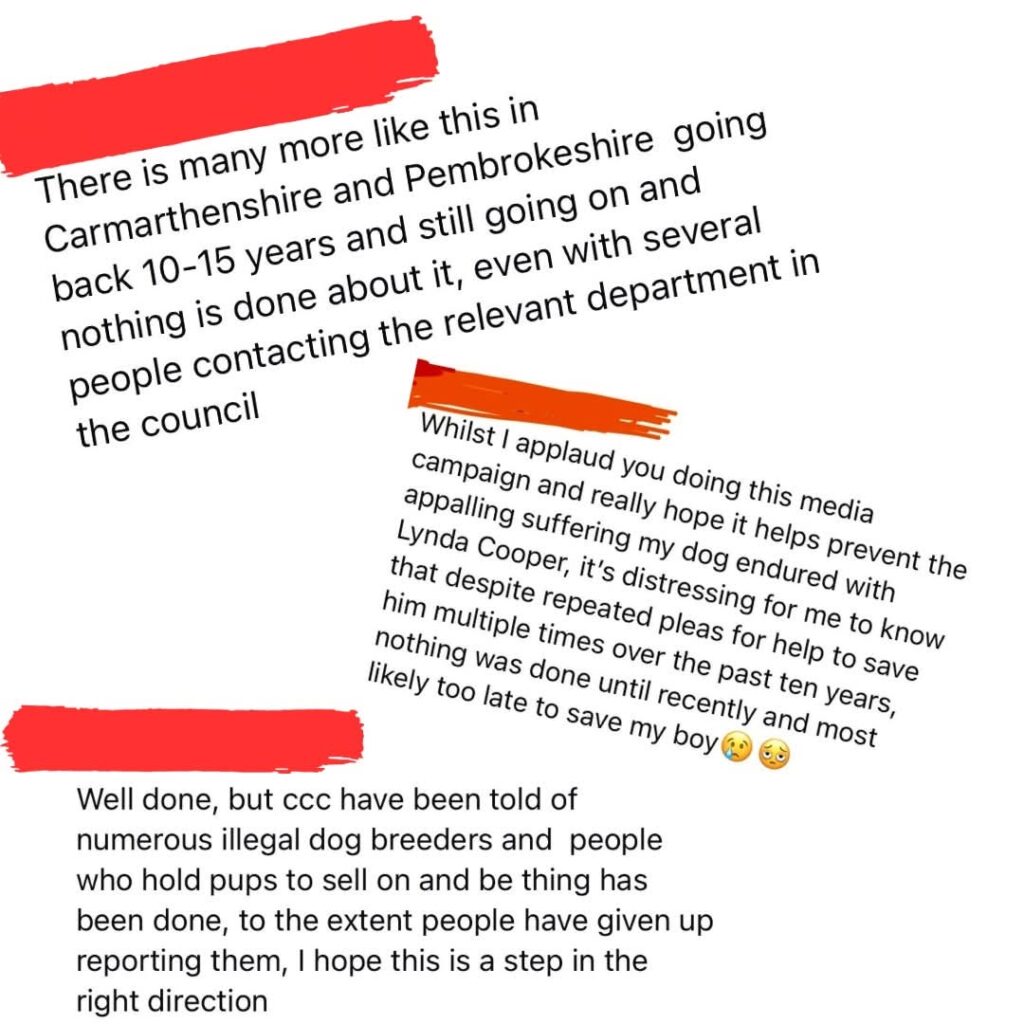
So knowing how long it can take for authorities to act, I wondered if people would still consider it worth reporting their suspicions about illegal, or low welfare breeders. My sample size is small, my Facebook page has under 15k followers, and I didn’t ask the question because I think it has any validity beyond me seeing what a tiny fraction of people who follow me think.
What I next wanted to ask, but haven’t yet, is inserting into the original question, these words,
If you were running a rescue and…
…you knew or suspected that dogs were in a breeding situation which caused them to suffer. Would you…
I wonder how people’s responses might differ if I asked that question.
The relationships between rescues and breeders is a thorny one to unpick. It is also very difficult to get genuine insights into the relationships between them. Not many want to talk about this area of rescue. Some have the worry that if they call out, or officially report breeders they take dogs from, it dooms other dogs who will have no safe place to go once their breeding lives are finished. There are also concerns about rescues being targeted by criminal elements in the breeding world, should they report what they know. While others simply don’t see it as their responsibility to get involved in reporting welfare issues in the dogs that come from the breeding industry.
A few weeks ago a post on social media came into my newsfeed and made me sit up and take notice as I have been thinking a lot about this topic this year (for reasons my next blog will explain).
Jack Linnell, Director of St Giles Animal Welfare, a not-for-profit organisation based in Somerset was addressing online comments from people accusing the organisation of ‘supporting puppy farms’. In a lengthy post (which can be read in full here), he explains that he doesn’t see a puppy farm, he sees ‘the individual animal standing in front of me’ and understands why people worry that by taking in puppy farm dogs it benefits the breeders, he goes on to say it’s a valid discussion to have.
I agree. He provided an email address in his post welcoming ‘open discussion’. I emailed him twice, explaining I am a writer and am interested in understanding this area of the breeding industry more. At the time of writing I have had no response.
The broad explanation in his post is that helping individual animals is the main driver behind decisions. He gives an interesting analogy,
“Social services don’t choose which children deserve help based on where they’ve come from – they help the individual in need. For me, rescue is exactly the same. At St Giles, our purpose is to help animals that need us.’
Which is a curiously limited perspective and it overlooks, or ignores, the responsibilities that social services have towards preventing other children suffering, and to bringing perpetrators of cruelty and neglect to justice. Is rescue not the same? If Jack Linnell had replied to my emails to his invitation to engage in open and valid discussion, this is one of the questions I would have put to him.
When I wrote ‘Saving Susie-Belle’ in 2013, I wanted to include details about the place she was rescued from. Actual facts, not vague generalisations. I asked her rescue, Many Tears, but nothing was forthcoming. I was naive at the time and thought they would welcome an opportunity to present facts. I also received a telephone call from the bad tempered owner of the rescue (this was before it was a charity) who in no uncertain terms told me she did not want the rescue’s name associated with Susie-Belle, me, nor anything I wrote.
Under Sylvia Van Atta’s leadership Many Tears Animal Rescue has gained a lot of experience working with breeders, aka puppy farmers. As she is no longer CEO and this large rescue is undergoing changes, I wondered whether there would be any change in her publicly stated position of not reporting breeders. In a 2023 news article she described their relationships,
“They call me because they know all know about me, I am not going to scream and shout at them, I can try and educate them, but I just want to help the dogs.”
I wonder if she had any success educating them.
Unlike Jack Linnell, I did receive a reply from one of the current Many Tears Trustees. Here’s their position regarding reporting welfare concerns,
“The welfare issues associated with some breeding establishments are clearly matters of significant public concern, and we recognise the moral and ethical considerations that can arise when rescue organisations become involved in taking dogs from such environments.
Many Tears’ charitable purpose remains the rescue, rehabilitation and rehoming of dogs in need. In that respect, our primary focus continues to be securing the best possible welfare outcomes for the individual dogs that come into our care.
As with many rescue organisations, situations are considered on their individual circumstances. Where appropriate, we work with the relevant authorities and other agencies, but we do not believe it would be appropriate to comment on or set out operational approaches in relation to hypothetical or specific cases.
Whilst the charity has undergone changes in governance in recent months, there has been no change to our fundamental mission of prioritising the welfare of the dogs entrusted to our care.”
Like St Giles’s position it focusses on individual dogs. But, Many Tears governing document (available on the Charity Commission’s website), states the charitable objects (purpose) include “the advancement of animal welfare to prevent cruelty to animals and the relief of suffering by animals.”
A question arises. When the places individual animals come from are known, and conditions in them are seen to cause the animals to leave in states of obvious neglect and suffering, should preventing cruelty and neglect to others in future, or those remaining in place, be part of a rescue’s responsibility?
These are difficult questions, and the answers may not be as black and white as those given by people answering as individuals not rescues, on my simple Facebook post. But should it be any different? After all, rescues have access to those causing suffering, often over many years, and they can provide valuable evidence which would help to build prosecution cases.
I used to sit on the fence. Then I came to believe that rescues do have an obligation to work with the authorities to report breeders where dogs are clearly leaving them in states of neglect. Just as I have always believed that puppy buyers should report when they know something is wrong. I don’t think anyone with knowledge should sit on it and leave it to others to report, or speak up. I acknowledge it is not easy, and for small rescues with limited resources (financial, time, and others), it can be an almost impossible expectation, they are faced with enormous demands taking care of animals in dreadful states and many operate constantly at almost breaking point. But for the larger rescues, like Many Tears, with paid staff and budgets and access to other resources, is it acceptable that they don’t report and play their part in providing evidence of ill-doing?
Having said all this, my next blog will give an example of why I fully understand why people do not report. I will show why giving reports to the authorities can feel like a complete waste of time and effort, be demoralising and require far too much of rescues.